I like the effect although I would use linen so I could do more threads per inch to get more dense colour for the background. It would also be easier with a higher count to pull out the details of the design. And I think it would be better to actually plan the design on graph paper, especially since Susan at Crazy Quilt Susan has provided a link to make custom graph paper. I'm sure you can see it is more than a bit asymmetrical.
Saturday, April 28, 2007
TAST 17 Running Stitch
For some reason I had a different idea about what to do with the running stitch this week. I like all the patterns and ideas from Sharon B and Elizabeth at Quieter Moments, and we even had an darning pattern sampler class at one of my EGA chapter meetings. But I kept seeing something that was sort of like Assisi work in my head. I wondered if running stitch could be used for something more organic. So I drew a design from a Persian carpet book I am reading on some 18 count aida cloth and filled things in. I like the effect although I would use linen so I could do more threads per inch to get more dense colour for the background. It would also be easier with a higher count to pull out the details of the design. And I think it would be better to actually plan the design on graph paper, especially since Susan at Crazy Quilt Susan has provided a link to make custom graph paper. I'm sure you can see it is more than a bit asymmetrical.
I like the effect although I would use linen so I could do more threads per inch to get more dense colour for the background. It would also be easier with a higher count to pull out the details of the design. And I think it would be better to actually plan the design on graph paper, especially since Susan at Crazy Quilt Susan has provided a link to make custom graph paper. I'm sure you can see it is more than a bit asymmetrical.


One of my other distractions
As well as work and vacation distractions over the past month, we also have the distraction of a new marine fish tank. This has been a great experience for the whole family. A new pet store had marine kits on sale and we have always wanted a marine tank - we gave away our freshwater fish tank when we moved in 2004. We decided we really wanted a reef tank because of all the beautiful corals so we picked up a couple of books when we purchased the tank. My older daughter has read the books through a couple of times now so she is the expert in the house.
The first thing we learned was that making space in one place requires moving many other things when your house is at capacity. The shelf we moved to make room for the tank stand had to go in the guest room/library and the desk from that room had to be moved to the art studio/garage for the sewing machine, and the shelf for backpacks that was displaced by the desk had to move to the other side of the doorway where it displaced a metal shelf which was moved to the attic where it displaced a small chest of drawers which luckily fit in the guest room/library that really did need a chest of drawers anyway. This all took several hours to accomplish since drawers and shelves had to be unloaded and loaded.
The next thing we learned is that marine aquariums require patience, lots and lots of patience. After conditioning the water we put live sand in the bottom of the aquarium which had to sit for a few days. Then we had to get live rocks (from Tonga and Hawaii) and let them site for a while - luckily this was while we were on vacation so it wasn't too bad. Otherwise we would have been watching this for a week.
 Then finally we put in a few corals and a shrimp and hermit crabs and two snails and a fish. Later that week we added another fish and then later another coral. Now we have to let things balance again before adding a few more corals and one or two more fish. We also put a blue backing on the outside of the tank to highlight the colour.
The first thing we learned was that making space in one place requires moving many other things when your house is at capacity. The shelf we moved to make room for the tank stand had to go in the guest room/library and the desk from that room had to be moved to the art studio/garage for the sewing machine, and the shelf for backpacks that was displaced by the desk had to move to the other side of the doorway where it displaced a metal shelf which was moved to the attic where it displaced a small chest of drawers which luckily fit in the guest room/library that really did need a chest of drawers anyway. This all took several hours to accomplish since drawers and shelves had to be unloaded and loaded.
The next thing we learned is that marine aquariums require patience, lots and lots of patience. After conditioning the water we put live sand in the bottom of the aquarium which had to sit for a few days. Then we had to get live rocks (from Tonga and Hawaii) and let them site for a while - luckily this was while we were on vacation so it wasn't too bad. Otherwise we would have been watching this for a week.
 Then finally we put in a few corals and a shrimp and hermit crabs and two snails and a fish. Later that week we added another fish and then later another coral. Now we have to let things balance again before adding a few more corals and one or two more fish. We also put a blue backing on the outside of the tank to highlight the colour.
As you can see there is now some colour and movement in the tank.
 I'm very fond of this rock with yellow polyp and green button corals.
 This is Zipper (I know it is blurry but it is really hard to get a photo). He is a six lined wrasse. We also have a Hippo Tang (blue fish like Dorey in Finding Nemo) and of course her name is Dorey.
They sun polyps aren't open much yet and the Kenya Tree leather coral is sort of floppy although the polyps all come out each day. We are now getting some algae build up on the glass and rocks but I understand from the books that this is all part of the mini-ecosystem we are trying to create. Luckily there is a very good marine aquarium shop nearby that has been most helpful in answering all our questions and recommending the easiest and heartiest fish and corals. It is fun to visit the shop with all the beautiful aquaria filled with colourful and amazing fish and invertebrates. There are a couple of giant tanks, one with a giant clam, that are truly spectacular and I can't even imagine how much they would cost to set up and keep. For now I am quite happy with our 29 gallon tank and the interesting creatures we have so far.
Tuesday, April 24, 2007
TAST 16 Palestrina knot
 Another new stitch for me this week, which is always fun. I've cropped out my boring learning rows and just put out the good stuff. The purple lavender flowers are closely spaced knots in linen thread which makes a great texture. The lavender leaves are a version of Palestrina from my old favourite, Donna Kooler's Encyclopedia of Needlework, called Palestrina knot with legs. I used two strands of perle cotton that had the right shade of greyish green. The trees are the opposite, tops in Palestrina with legs and trunks in close knots, all with 6 strands of floss.
With so many of the stitches we are learning I find it amazing that thread and spacing can make a huge difference in how a stitch looks. And it is nice to experiment on something small - I've never been a doodle cloth person and now I see that you miss something when you don't play around with a stitch. Thanks Sharon!
Tuesday, April 17, 2007
TAST 15 Oyster stitch
 I don't know why but the oyster stitch reminded me of a thumbprint and those books of making things out of thumbprints, so I went with the idea and came up with this. I used some alpaca wool I had from a previous project to make the sheep woolly.
Monday, April 16, 2007
Trip to England
 Just came back from a wonderful 8 days in London, England. Sunny every day and in the 70s, so it was great for all the walking we did. I was able to tour through two gardens. The knot garden at the Museum of Garden History - which I was able to get as a kit for cross stitch and of course I started it on the plane - see above. I also toured the gardens at Kew, which didn't involve any embroidery but I love the gardens.
The other embroidery stop was the Victoria & Albert Museum. The textile area was closed on the day we went, but I found lots of textiles in other parts of the museum to drool over, including the Martha Edlin casket and some stumpwork mirror frames.
Of course we saw all sorts of castles and houses and museums and the Globe Theater and even went to a classical choral concert at St. Martin's in the Fields church. All in all an excellent trip.
Friday, April 06, 2007
Hoppy Spring


My EGA chapter did mailable stitched envelopes for this year's president's challenge. The envelope had to be designed for a special day. I sent off a spring flowers envelope for the first day of spring. This week I received a bunny decorated envelope for Easter. Merry Susan stitched these and then tucked a really nice scissor fob chart into the envelope. I love it!
Thursday, April 05, 2007
TAST 14 Bonnet Stitch
 I had such fun doing this! I started with a couple of lines of the stitch to figure it out, but then realized that it looked very different depending on spacing and height and thread. As I thought about it, I realized that the closely spaced, short stitch looked like a rock path, and of course I thought gardens. I guess cleaning out the pond in the back yard made me thing pond - my pond is not that blue though. After the rounds of blue, brown and green, I did individual bonnet stitches for the flowers. I was going to just do French knots, but decided to try the bonnet stitch since I'm trying to only use the stitch of the week. It turns out they look a bit like tulips! Then of course, I realized that in orange the individual stitches could look like fish.
Friday, March 30, 2007
3-D Boquet DONE! (for now)
 Since I had a few comments on doing the stumpwork petals for the first fritillary flower I thought I'd do the next set as a demonstration. The First on the left is the couched wire. You can see I used a plastic coated copper wire and only one wire sticks out - this is so I only have 6 wires for the stem when I'm done. This particular flower is based on a Jane Nicholas flower (unlike the others that I designed myself) and you can see a bit of wire sticking into the petal. This is because the real petals actually have a line like this that sticks out (see photo in previous post) The second petal has the wire covered in buttonhole. The third shows the start of the satin stitch layer in the lightest colour. You can see it goes under the wire that sticks into the petal. The fourth shows the finished satin stitch, with the tip of the wire under a few threads. The fifth petal shows the darning stitch used to get the checkered pattern. And the sixth is the finished petal. This time instead of detached buttonhole petals I tried doing the satin stitch on muslin technique like the petals, being very careful to make the backs completely covered.
And the completed stem, with two flowers and two leaves is below.
 Then I put all my flowers together as a posy.
 Now that I actually have spring flowers blooming (first tulip today) I don't feel the same urgency to design more - maybe next January. In the meantime, I have several WISPs I would like to work on, and a few other ideas in my head. The laidwork pattern I did for the TAST couching stitch looks like it would make an interesting brick pattern in a knot garden and I have been pouring over Embroidered Knot Gardens: Using Three-Dimensional Stumpwork, Canvas Work & Ribbonwork by Owen Davies and I'm thinking I might start planning!
Wednesday, March 28, 2007
TAST 13 Knotted Cretan
 I was able to get a peek at TAST 13 during work yesterday and after mulling over the organic, textured aspects of the stitch, I had an idea to work on last night. I guess I had cherry blossoms on my mind. I did do some test rows on a separate piece of aida cloth (which is the only way I can come close to stitching a straight line), and it seemed to me that 2 strands of floss just didn't give much texture, so I used 6 strands for the trunk and leaves and three stands of the pink with 2 strands of Krenick filament added - although the sparkle is hard to see in the photo.
Although this little tree isn't perfect, it does make me realize that there can be impressionistic needlework as well. I was able to move my watercolour painting to a new level with a teacher who showed me how to be looser with my forms and colours, and I see that the same can hold true for needlework. I have been concentrating on realism with my 3-D flowers and I really love them that way, but I can see doing a piece with looser stitching and a more Monet like feel. It will be something to note in my journal and come back to when I'm ready to do another framed piece.
Saturday, March 24, 2007
TAST 12 Couching - Kicking it up a notch.
I haven't had time to surf the TAST web ring for a while so before starting to stitch on Thursday, with my trusty cup of coffee at hand, I began my journey and the blog right after mine on the list was so great! Here is one of the posts from Amy of In The Fold showing her fabric postcards with the TAST stitching. But be sure to look at all her work. Then I was guided to an absolutely fantastic up and down buttonhole Stonehenge by Pat. They are doing such creative and beautiful things it really made me reconsider what I have been doing with my TAST samples. I know that 'If you compare yourself with others you may become vain and bitter' but in this case I was inspired to try harder to make my own work more challenging.
 I decided originally to use the challenge to create a stitch book of my own, and quickly realized that it was also a good way to try new threads and fabrics and colour combinations. But as I look through my samples I realize that the ones I like best and enjoyed stitching the most were the ones that were more than just rows of stitches. So, unless I really need to do some practice rows, I'm going to stitch something other than rows. I also tried to use only the stitch of the week in my work, and I'll try to stick to that unless I find myself blocked by it.
So this week I have two couching designs. The first is gold Krenick braid in a laid work pattern based on a chimney at Hampton Court Palace. I sketched the design in my visual journal (thanks Sharon B) and then was able to use a ruler to find the common lines to lay the long threads. I'm quite happy with this one and will use the pattern in other things.
The sunset interpretation is made with Bayeux stitch, which I learned about from a post by Carol-Ann at Threads Across the Web. I have been watching her progress on a Japanese embroidery with great interest and her stitching is exquisite.
For those awaiting spring, it is spreading north. I have snowdrops, squill, hyacinths and daffodils, but the crocus have finished. And my Lenten rose now has THREE flowers. I realize there are some of you over in GB who will laugh at such a thing, but it is a big deal for me.
Saturday, March 17, 2007
TAST 11 Up and down buttonhole
I didn't get a chance to think of this week's TAST until yesterday and lucky for me Sharon posted about Elizabeth's 3 pronged up and down stitch. As I looked through Elizabeth's variations, I was taken with one that looked like a flower (what else) at the end of the next entry. Actually, all of her variations are wonderful. I am in awe of so much talent - be sure to check out Elizabeth's Quieter Moments blog.

So last night, I made sure I could actually do the up and down buttonhole with a row, then I tried the pattern, all with my favourite floss of the moment, DMC Colour variations. I love this pink/orange variation. I started on 25 count Dublin linen, a very early purchase which I've decided was a mistake, but I see some potential for pulled work with it. Then used a 35 count Belfast linen with the same count in the pattern and I think I like the design even better in the smaller form.
The big excitement this week was finally have the girls' hair cut for Locks of Love. It wasn't as traumatic as expected for them, but now they both look older so it is traumatic for me. But I'm proud of both of them.
Thanks to everyone who has posted comments recently. It is great to get feedback on the things I am doing and I value everyone's opinion.
Friday, March 09, 2007
TAST 10 Barred chain and Stumpwork Fritillary
 This week I decided to try something completely different and so, inspired by Sharon B's embroidery samples I made a colourful pattern out of barred chain. It was great fun and helped me learn alot about colour combinations. I also wish I'd used more textures as well, since I was only using the one type of stitch. But all in all I'm happy with it.
Below is my first fritillary flower. I tried wrapping the wires to form the stem but I didn't like the way it looked so I went back to the floral tape. I find I can get the wires together much tighter this way, which makes a big difference when trying to bend wires to adjust the way the petals fall. I still need to do another flower and two leaves to finish the full stem. I think I'll make the petals slightly wider on the next flower because they don't' quite overlap the way they do in the picture I posted. And since none of my fritillaries are in bloom right now in the garden, I can't check a real flower.

Wednesday, March 07, 2007
Old WIP returns to the light

Although I am really enjoying my new job, I must admit that I am exhausted. I am used to getting up and puttering around the house for a while, picking up. doing a load of laundry, etc. then getting down to work at the computer. I was very lucky that a new job presented itself just as the at home computer job finished, but I have to get up earlier and get out of the house before everyone else. I still want to do needlework in the evenings, but I'm too tired to create anything, so I looked through my WIP kits and such and found an Irish stitch pocketbook that I had started a few years ago. It seemed perfect, but then I remembered why I stopped working on it - I couldn't count the threads. Well, since then I have been fitted with bifocals and I have a magnifier, so it turned out fine, except the first rows of stitching had to compensate for my old miscounts!!! But it is fine now and stitching up much quicker with the extra magnification. I have done another pocketbook, also an Examplarery design by Joanne Harvey, The Henry Row Pocketbook Kit.

I have one garden photo to show off, my first ever Lenten Rose. I have been trying to grow these without success for 10 years in NY and now here in VA for 2 years. When I first planted this one, the lovely man who does the mulch covered it up and I had to rescue it. It have finally recovered and this spring I have 1 flower - yes ONE. But I am still excited. I don't think I'll ever have a drift of Hellebore's like I see in English garden photos, but I got one to bloom.

By the way, if you like to be inspired by old botanical prints, try going to A Modern Herbal, an online version of a book by Mrs. M. Grieve, first published in 1931.
Thursday, March 01, 2007
TAST 9 Cross stitch

Since my first embroidery work as a child was cross stitch and then my first pieces when I returned to embroidery as an adult were reproduction samplers, I felt quite at home with this week's stitch. I am also working on the EGA Counted Thread Mastercraftsman program, specifically the first step which is to design a cross stitch sampler. I have just started a family sampler using the names of the women in my Mother's family. All the borders will be of Hungarian design, since that is where the family is from. I'm using patterns from old Hungarian pattern books.
The next step in the program is Assissi work, and I was reading that the background can be cross stitch, long armed cross or two-sided Italian cross, so I thought I would test these stitches to see what would be a suitable background. Then I went on to test various other cross stitch variations. I hope you can read all my labels when you click on the photo. (The yellow stitches were a test of row vs. single crosses. Not a huge difference if done carefully, but my upright was not done carefully!)
After doing very small areas, it seems that cross stitch would be the fastest to fill the background of Assissi work. However, the long arm and Italian stitches do give better coverage, but they take forever and I would have to work out ending compensation stitches. I especially like the two colour rice stitch but it is labour intensive so it could not be used for really large areas. The Smyrna cross is a fun stitch and while coverage is good when done over two threads, I really like the star effect when done over 4.
Sunday, February 25, 2007
TAST 8 Fly Stitch and stumpwork
Other commitments kept me from TAST earlier this week, but that was fine because this morning I was able to surf around the blogs and get inspired. This week I was taken with the fly stitch wheel and kaleidoscope that Mary sketched and stitched and did my own starburst sort of design. I'm also learning about colour so I tried working on a monochromatic colour scheme.
 I have used fly stitch in the past as leaf and stem parts of plants.

Finally, I have been working on my latest 3D flower. This one is going to be a fritillary

Luckily I had a pattern this time, from Jane Nicholas beetle book. She has hers done as regular stumpwork with 1 full petal and two partial petals sticking out from the fabric. But I did all the petals with the one pattern and used her suggested weaving pattern - and her suggested DMC colours. I 'm making two flowers on one stem so I drew all 12 petals on the same piece of fabric, but then I realized when I had the first six done that I had to see how the flower would look. I'm still working on the stamens, but I have cut out the petals and held them together and I think it will look good. Of course that wastes some material but I just had to cut them out!

 I have used fly stitch in the past as leaf and stem parts of plants.
Finally, I have been working on my latest 3D flower. This one is going to be a fritillary

Luckily I had a pattern this time, from Jane Nicholas beetle book. She has hers done as regular stumpwork with 1 full petal and two partial petals sticking out from the fabric. But I did all the petals with the one pattern and used her suggested weaving pattern - and her suggested DMC colours. I 'm making two flowers on one stem so I drew all 12 petals on the same piece of fabric, but then I realized when I had the first six done that I had to see how the flower would look. I'm still working on the stamens, but I have cut out the petals and held them together and I think it will look good. Of course that wastes some material but I just had to cut them out!

Wednesday, February 21, 2007
Reviews of needlework related books
While I contemplate what to do with the fly stitch (TAST 8) I thought I would share some short book reviews I included in my EGA chapter newsletter. I only own the first of these books, the other two were borrowed from my local library - in fact I found them on the new books shelf! Be sure to check out the great things in your local library.*
Women’s Work, the First 20,000 Years: Women, Cloth, and Society in Early Times. By Elizabeth Wayland Barber
Published by Norton, 1994.
My husband learned about this author and book from one of the weavers in Colonial Williamsburg. She was conducting a sheep program that my husband and daughters were attending, and when she mentioned this book, he thought of me and wrote it down.
Women’s Work is an excellent history of cloth, and the social and political place of cloth and the women who wove it, starting with the Paleolithic period. Wayland Barber has had to piece together archaeological evidence from around the world to tell the story of weaving and cloth. Even where written records exist and can be deciphered, women were not often mentioned. It is interesting that embellishment and decoration are seen on the earliest pieces of cloth, as if the need to be artistic is a very early instinct in humans. The book is well written and very interesting, and since cloth is integral to embroidery, it is helpful to see where it all started.
1066: The Hidden History in the Bayeux Tapestry.
By Andrew Bridgeford.
Bridgeford gives a convincing account of an alternative history for the Battle of Hastings found in the subversive stitching of the tapestry—which of course isn’t a tapestry at all, but rather a very long embroidery. The are colour figures of the whole tapestry and close ups of some of the noted sections. Even if you don't agree with the interpretation, it is still interesting to get a closer look at the tapestry.
The Root of Wild Madder: Chasing the History, Mystery, and Lore of the Persian Carpet.
By Brian Murphy.
Murphy is a political reporter who loves carpets, so the story of finding the patterns and dyes used throughout history is woven with the story of the politics of the region right now. You will be glad you are relaxing in your nice clean home when you read this book. But it is very exciting and interesting.
*Yes I'm a librarian plugging for library use. Be sure to check if your local library is on the Internet. I can search for books, renew books and put holds on books while sitting at my desk at home. Very convenient.
Women’s Work, the First 20,000 Years: Women, Cloth, and Society in Early Times. By Elizabeth Wayland Barber
Published by Norton, 1994.
My husband learned about this author and book from one of the weavers in Colonial Williamsburg. She was conducting a sheep program that my husband and daughters were attending, and when she mentioned this book, he thought of me and wrote it down.
Women’s Work is an excellent history of cloth, and the social and political place of cloth and the women who wove it, starting with the Paleolithic period. Wayland Barber has had to piece together archaeological evidence from around the world to tell the story of weaving and cloth. Even where written records exist and can be deciphered, women were not often mentioned. It is interesting that embellishment and decoration are seen on the earliest pieces of cloth, as if the need to be artistic is a very early instinct in humans. The book is well written and very interesting, and since cloth is integral to embroidery, it is helpful to see where it all started.
1066: The Hidden History in the Bayeux Tapestry.
By Andrew Bridgeford.
Bridgeford gives a convincing account of an alternative history for the Battle of Hastings found in the subversive stitching of the tapestry—which of course isn’t a tapestry at all, but rather a very long embroidery. The are colour figures of the whole tapestry and close ups of some of the noted sections. Even if you don't agree with the interpretation, it is still interesting to get a closer look at the tapestry.
The Root of Wild Madder: Chasing the History, Mystery, and Lore of the Persian Carpet.
By Brian Murphy.
Murphy is a political reporter who loves carpets, so the story of finding the patterns and dyes used throughout history is woven with the story of the politics of the region right now. You will be glad you are relaxing in your nice clean home when you read this book. But it is very exciting and interesting.
*Yes I'm a librarian plugging for library use. Be sure to check if your local library is on the Internet. I can search for books, renew books and put holds on books while sitting at my desk at home. Very convenient.
Sunday, February 18, 2007
Band RR second round

I am so excited to be a part of a Sampler Band Round Robin. I've never done any sort of RR (unless you count the names on the membership band for our EGA chapter) so I have been looking forward to starting with this group. This piece was started by ktj of Katie's New Place.
Usually I take quite a while to decide on things for non-kit projects. I went through multiple ideas for the two President's challenges I've done for my EGA chapter, so I expected the band sampler RR would be similar. But somehow it wasn't. There were multiple inspirations that all lead to this band. When it arrived we had just started planning a trip to England for the spring, and I was checking the growth of my outdoor bulbs every day, and I was working on a bookmark of London motifs for my daughter (in the post below). At the same time I've been reading a book on symbolism in art and I wanted to include some special things to give the band meaning. The British and garden themes led me to patterns from another bookmark I had finished that had medieval garden motifs. I did some modification of the motifs and used many of my new colour variation DMC flosses to create what I hope is a lovely spring garden that comes after the wintry first band of this sampler. There are bees/honey for sweetness and water for tranquility. I realize the pictorial aspects of band samplers are usually at the bottom, but think of this as a minor update.
Saturday, February 17, 2007
TAST 7 Feather Stitch
 I had one of those weeks where I lost track of the days, but that doesn't mean I didn't stitch. For this weeks sample, I tried stitching on a piece of black linen I received in a sample pack. I have always liked to look of black backgrounds, but I've never tried one so I thought this would be a good chance. I was surprised to see that the silver blending filament I used on the third row of double feather and closed feather stitching did not show up that well - even worse on the photo. On the other hand, all the floss colours I tried look quite nice. I especially like the feathered chain stitch - fourth row down in green. Because I am doing a stitch book, I've been trying to only use the one stitch in my sample, but I really like the use of feather with other stitches like the seems Ati has done. Since I mainly do embroidery, especially flowers and gardens, the packed feathered chain in white and purple at the bottom of my sample interest me because I can see doing long arching rows in green to make trees.
Below are a couple of my other projects of the week (I have also been working on a band RR and I had to wait until today to get muslin for more 3-D flowers). The top is purchased bookmark material with horses from a pet cross stitch book. I did the horses in the colours my younger daughter wanted. The left is the Appaloosa pony she shows, the middle is a bay, and the right is a fantasy horse with a silver tail - note that the silver seems to show up better here than on the black.
 This bookmark is from a kit we purchased in England two years ago. My older daughter wanted to make it. She decided after starting the border that she didn't like cross stitch so it has been sitting since then. We are now planning another trip to England and I had the urge to stitch something British, so I confiscated the kit and made it up for her, which she was happy with.
I also practiced my lute a bit. I am working on two pieces that have a know tune since that makes it easier to tell if I'm actually playing it correctly. It is sounding a bit better. I received peg dope and some better quality strings for Valentines day (who needs chocolate) so I'm hoping to work with those tomorrow to see if the sound quality improves a bit. I'm hoping the peg dope will make it easier to tune the 13 strings and the better strings should reduce the buzzing on the lower notes. I'll keep you posted.
Friday, February 09, 2007
TAST 6 Algerian Eye
 While looking for another pattern this week, I came across an old Leisure Arts leaflet by Betty Burchfield called Needlepoint Borders. It had a really neat woven ribbon design using the border patterns which inspired me to try my own ribbon piece. Not only did I try lots of colours and stitches but I had to do some compensation stitching which is always good practice. I used all DMC floss, except the light pink small flowers which are Weeks Dye Works floss. The red and blue band is the new colour variations DMC floss. I purchase a 12 pack with the weekly coupon from Michaels and I'm very pleased with the way the variegation looks, much better than the old variations floss and better colours too.
On an historical note, I found eyelet stitch in two reproduction samplers I have done which points to the utility of the stitch.
Thursday, February 08, 2007
So many projects, so little time...
I am busy working on a more complicated than usual TAST sample this week, but in the meantime I wanted to share some of the different things I've been working on lately.
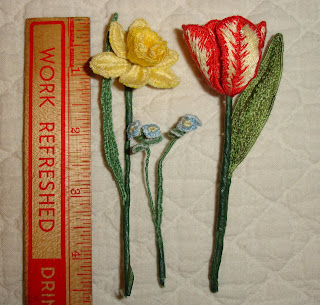
I finished another 3-D stumpwork flower.
 ktj asked me what size they were, so here are all three I've done so far with a ruler:
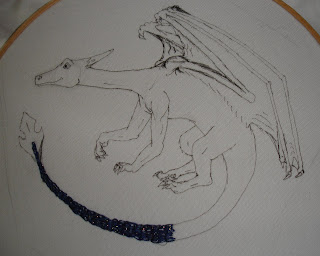
My daughter had some time this weekend to draw me a dragon to stitch to put in the middle of her CQ pillow. I decided to try to imitate scales by covering the dragon in detached chain stitch (TAST 3 so I'm in practice). I've used some dark blue variegated DMC floss with a strand of peacock blending filament. I hate blending filament but it looks nice - hard to see in the photo but in real life it just gives a bit of extra depth to the colour.
 I've also been working on this year's President's Challenge for my EGA chapter. Some Stitching Post members may remember that I wanted advice on what to put in a fabric envelope, because the challenge is to stitch an envelope and send a token gift to another member in it. The recipient is a secret until it arrives. It also has to have a holiday theme - although any sort of special day will do (maybe Talk Like a Pirate Day?). So I'm sending a spring envelope. This scene - based on some DMC charts - is under the envelope flap so it won't get ruined in the mail. It has been fun to design the envelope, but now I have to line it and sew it up so I hope it works!

I finished another 3-D stumpwork flower.
 ktj asked me what size they were, so here are all three I've done so far with a ruler:
My daughter had some time this weekend to draw me a dragon to stitch to put in the middle of her CQ pillow. I decided to try to imitate scales by covering the dragon in detached chain stitch (TAST 3 so I'm in practice). I've used some dark blue variegated DMC floss with a strand of peacock blending filament. I hate blending filament but it looks nice - hard to see in the photo but in real life it just gives a bit of extra depth to the colour.
 I've also been working on this year's President's Challenge for my EGA chapter. Some Stitching Post members may remember that I wanted advice on what to put in a fabric envelope, because the challenge is to stitch an envelope and send a token gift to another member in it. The recipient is a secret until it arrives. It also has to have a holiday theme - although any sort of special day will do (maybe Talk Like a Pirate Day?). So I'm sending a spring envelope. This scene - based on some DMC charts - is under the envelope flap so it won't get ruined in the mail. It has been fun to design the envelope, but now I have to line it and sew it up so I hope it works!
Subscribe to:
Posts (Atom)